

Super Mario Bros 3 Initial Release Date
| Super Mario Bros. 3 | |
|---|---|
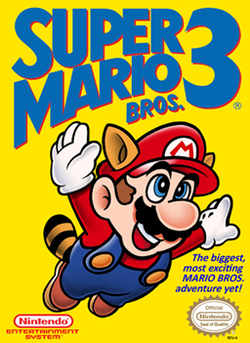 The encompass fine art depicts Mario, the chief protagonist, flying with raccoon ears and tail obtained from the new "Super leafage" particular. | |
| Developer(s) | Nintendo EAD |
| Publisher(s) | Nintendo |
| Designer(s) | Shigeru Miyamoto [1] Takashi Tezuka [one] |
| Composer(s) | Koji Kondo [ane] |
| Series | Mario |
| Platform(south) | Nintendo Entertainment System, PlayChoice-ten, Super Nintendo Entertainment System, Game Boy Advance, Virtual Console |
| Release engagement(s) | October 23, 1988
|
| Genre(s) | Platforming |
| Mode(s) | Single-actor, multiplayer |
| Rating(s) |
|
Super Mario Bros. 3 (スーパーマリオブラザーズ3 , Sūpā Mario Burazāzu Surī ), as well referred to as Super Mario 3 and SMB3 , is a platform video game developed and published by Nintendo for the Nintendo Entertainment System (NES), and is the third game in the Super Mario serial. The game was released in Japan in 1988, in the United States in 1990, and in Europe in 1991. Evolution was handled by Nintendo Entertainment Analysis and Development, led by Shigeru Miyamoto, who directed the game forth with Takashi Tezuka.
The game centers on the quest of Mario and Luigi to salve the rulers of seven kingdoms from Bowser, the series' antagonist. The ii brothers must travel across eight worlds to restore society to the Mushroom Globe. It built on the game play of previous Mario games by introducing new power-ups that broaden grapheme abilities, and established conventions that were carried over to futurity games in the series.
Prior to its private consumer North American release, game play footage from Super Mario Bros. 3 appeared in the Universal Studios pic The Wizard, which helped fuel the game's anticipation among fans. Upon its release, the game was commercially successful and has since become one of the best-selling video games in the industry. Super Mario Bros. 3 was well received past critics and has been included in numerous lists of summit 100 video games. The success of the game resulted in an animated tv set show based on its elements, and in the game'southward re-release on later Nintendo consoles.
Contents
- ane Gameplay
- 2 Development
- three Reception
- 3.one Sales
- 4 Legacy
- four.1 Remakes
- 5 References
- 6 External links
Gameplay
Super Mario Bros. 3 is a two-dimensional platform game in which the player controls the on-screen protagonist (either Mario or Luigi) from a third-person perspective. The game shares similar game mechanics with previous titles in the serial—Super Mario Bros., Super Mario Bros.: The Lost Levels, and Super Mario Bros. two—just introduces several new elements. In addition to the running and jumping moves found in by games, the histrion can fly and bladder with the aid of special items, slide down slopes, and execute new types of jumps. [2] Super Mario Bros. 3 is set later on the events of previous games. Mario and Luigi embark on a mission on behalf of Princess Toadstool to stop Bowser and his children—the Koopalings—from terrorizing the kings of seven regions in the Mushroom World. The Koopalings stole the kings' magic wands and transformed them into animals. [3] Each region serves every bit a game globe that is divided into stage levels, and an eighth region is included every bit the final world, Nighttime Country. The 8 worlds characteristic singled-out visual themes; for example, the second world, "Desert Country", contains sand-covered levels with pyramids, while the levels in the fourth world, "Behemothic Land", are populated with obstacles and enemies four times equally large as other worlds. [four]
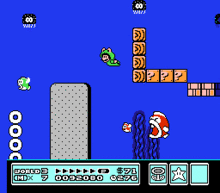

Super Mario Bros. 3 introduced several suits to alter the character's abilities. For example, Mario tin utilise the "Frog Arrange" to swim more easily in water, only will motion more than slowly on land.
The player navigates through the game via 2 game screens: an overworld map and a level playfield. The overworld map displays an overhead representation of the current earth and has several paths leading from the earth'southward entrance to a castle. Paths connect to action panels, fortresses and other map icons, and allow players to take different routes to reach the world's goal. Moving the on-screen graphic symbol to an activity panel or fortress volition allow access to that level's playfield, a linear stage populated with obstacles and enemies. The majority of the game takes place in these levels, with the player traversing the stage by running, jumping, and dodging or defeating enemies. [5] [6] [seven]
Completing stages allows the thespian to progress through the overworld map and to succeeding worlds. Each world features a final stage with a dominate to defeat; the first 7 worlds feature an airship controlled by one of the Koopalings, while the actor battles Bowser in his castle in the 8th world. Other map icons include large boulders and locked doors that impede paths, and special minigames that provide the player a take a chance to obtain special power-ups. A new feature is the player'south selection to save ability-up items obtained in minigames for after utilize via a card accessible at the overworld screen. [5] [half dozen]
In addition to special items from previous games like the "Super Mushroom" and "Fire Flower", new ability-ups are introduced that provide the histrion with new options. Items vary in scarcity; for example, ane-upwardly mushrooms, which give the thespian an extra attempt to play later the character dies, are abundant, while the "magic whistle", which enables the player to bypass sure worlds, only appears three times in the game. [8] The "Super Foliage" and "Tanooki Suit" give Mario raccoon and tanuki appearances respectively and permit him to fly for a short period of time. Other suits include the "Frog Suit," which increases the character's underwater speed and agility and improves jumping height on country, and the "Hammer Accommodate," which gives Mario the advent of the Hammer Bros. enemy and allows him to throw hammers at enemies and resist fire attacks. Some abilities provided past the suits are intended to give the player more navigation options in stages. For example, the Frog Conform allows the actor to access underwater pipes, and the Tanooki Accommodate can temporarily transform Mario into an invincible statue, reducing the threat of harm. [5] [6] [9] During the game, Mario tin can find a Warp Whistle, which will allow him to featherbed worlds. When using the Whistle, the tune played is the exact melody used from the Whistle in The Fable of Zelda.
Super Mario Bros. three includes a multiplayer choice which allows two players to cooperatively play the game by taking turns at navigating the overworld map and accessing stage levels; the first thespian controls Mario, while the other controls Luigi. Through this manner, players can besides admission several minigames, including a remake of the original Mario Bros. arcade game. [10]
Development

Shigeru Miyamoto, the producer for Super Mario Bros. iii, has been involved in the development of every Super Mario Bros. panel game.
Super Mario Bros. 3 was developed by Nintendo EAD, and took more than than ii years to complete. [1] [xi] Developer Shigeru Miyamoto directed the designers and programmers, working with them closely during the initial concepts and concluding stages, encouraging a free interchange of ideas. Miyamoto considered intriguing and original ideas to be key to creating a successful game. [one]
The game was designed to entreatment to players of varying skill levels. To assist less skilled players, bonus coins and extra lives are more arable in earlier worlds, while later worlds present more than circuitous challenges for more experienced players. In the two-thespian way, the players alternating turns to residue play time. [one] The development team introduced new power-ups and concepts that would give Mario the appearance of different creatures as a means of providing him with new abilities. An early on idea inverse Mario into a centaur, only was dropped in favor of a raccoon tail that allows express flying ability. [one] [11] Other costumes with different abilities were added to his repertoire, and levels were designed to take advantage of these abilities. [12] New enemies were included to add together diverseness to the game, along with variants of previous enemies, such as Goombas, Hammer Bros., and Koopa Troopas. [11] [12] The real life experiences of Miyamoto and his staff provided the inspiration for new enemies. For example, the idea for the Concatenation Chomp enemies (spherical, dog-like creatures) came from a bad experience Miyamoto had with a domestic dog equally a child. [1] Bowser's children were designed to exist unique in appearance and personality; Miyamoto based the characters on seven of his programmers as a tribute to their piece of work and efforts. [ane] [xi] The Koopaling'due south names were afterward altered to mimic names of well-known, Western celebrities in the English localization. [11] The Northward American release of the game featured some minor graphical differences, and (to reduce the difficulty) was inverse so that if Mario was hitting by an enemy, he would merely lose whatever power-up he had instead of shrinking to modest size similar in the original Super Mario Bros.
The character graphics were created past using a special graphics car ("Graphic symbol Generator Computer Aided Blueprint") that generated a collection of all the graphical shapes used in the game. Shapes in the collection were assigned numbers that the game's code uses to admission in real time, and are combined to form consummate images on the screen in real fourth dimension. [1] The Super Mario Bros. 3 cartridge uses Nintendo's custom MMC3 (Retentiveness Direction Controller) ASIC to enhance the NES capabilities. The MMC3 chip allows for animated tiles, extra RAM for diagonal scrolling, and a scanline timer to split the screen. The game uses these functions to split the game screen into two portions, a playfield on the top and a status bar on the bottom, allowing the top portion to scroll as the character navigates the phase while the bottom portion remains static to brandish text and other data. [13]
During 1988, a shortage of ROM fries, along with Nintendo of America's preparation of a version of Super Mario Bros. 2 for Western gamers (since the Japanese SMB2 was accounted also hard), prevented Nintendo from releasing SMB3 and another games (including, according to the mag "Nintendo Power", "Zelda Two: The Hazard of Link") in North America on schedule. [14] The delay, however, presented Nintendo with an opportunity to promote the game in a characteristic film. In 1989, Tom Pollack of Universal Studios approached Nintendo of America's marketing department about a video game movie; inspired by Nintendo video game competitions, Pollack envisioned a video game version of Tommy for younger audiences. Nintendo licensed its products for inclusion in what would get the film The Wizard. During the film's production, the filmmakers requested and were granted approval from Nintendo regarding the script and portrayal of the company's games. [15] Super Mario Bros. 3 was ane of the products shown in the motion-picture show, and was used in a last scene involving a video game competition. [15] [sixteen] The film was released in December 1989, a few months earlier the game was released. [17]
Reception
The game was well received past the video game press. Julian Rignall of Hateful Machines referred to Super Mario Bros. 3 as the "finest videogame" he had ever played, citing its addictiveness, depth, and challenge. A second Mean Machines reviewer, Matt Regan, anticipated the game would be a top-selling title in the Great britain, and echoed Rignall'south praise calling information technology a "truly brilliant game". Regan further stated that the game offered elements which tested the player's "brains and reflexes", and that though the graphics were uncomplicated, they were "incredibly varied". [5] In a preview of the game, Nintendo Ability gave it high marks in graphics, audio, challenge, gameplay, and enjoyability. [6] Border magazine considered Super Mario Bros. iii Nintendo'south standout title of 1989, and commented that its success outshone the first Super Mario Bros. 'south sales milestone; the first title sold twoscore million copies, but was bundled with the NES. [eighteen] They lauded the overworld map as an elegant alternative to a bill of fare to select levels. [xix] Allgame'due south Skyler Miller praised many of the game's elements: level blueprint, graphics, music, and nonlinearity. [seven] Dengeki referred to the game as a popular championship and expressed excitement over its rerelease on the Game Boy Advance system. [20] The in-game, hidden items were a well-received chemical element. [21] Rignall considered them a component of the game's addictiveness, and Sheff stated that finding the undercover items in the game, such as the whistles, provided a sense of satisfaction. [5] [22]
Criticism focused on different aspects of the game. Miller considered the exclusion of a system to save progress a drawback, while Rignall described the audio and visuals every bit being outdated compared to games on the new Sega Genesis and Super Nintendo Entertainment System (SNES). [5] [7] These two problems would be fixed in the game's remake for Super Mario All-Stars in 1993. The game was also criticized for its comparatively high difficulty level.
Super Mario Bros. 3 has appeared on numerous top video game lists. The game debuted on Nintendo Power 'south Acme xxx list at number xx in September 1989. [23] Information technology entered the listing'southward tiptop 10 a few months after and reached number ane in May 1990. [24] [25] Super Mario Bros. 3 remained within the top 20 for more five years. [26] More than a decade later on, the magazine ranked the game number six on their list of 200 Greatest Nintendo Games. [27] In August 2008, Nintendo Ability listed Super Mario Bros. iii as the second best Nintendo Entertainment System video game, praising it for making the series more complex and introducing new abilities that take since become signature abilities in the series. [28] The game placed 11th, behind Super Mario Bros., in Official Nintendo Magazine 'southward "100 greatest Nintendo games of all time". [29] In 2007, Screwattack called Super Mario Bros. iii the all-time Mario game in the serial too as the best game on the NES, citing the graphics, ability-ups, secrets, and popularity, summing it upwardly as "information technology is just incredible" and "If you lot haven't experienced this greatness, we pity you". [21] [xxx] In a poll conducted by Dengeki, it tied with Super Mario Globe equally the number three video game their readers showtime played. [31] The game has been ranked on several of IGN's lists of "summit games". In 2005, they rated it 23rd amongst their Top 100 Games, and praised the precise and intuitive controls. [32] IGN editors from the United States, United Kingdom, and Australia ranked Super Mario Bros. 3 number 39 in their 2007 Top 100 Games, citing Miyamoto'south "ingenious" designs. They further commented that the game improved on the "already-vivid concepts" of the previous titles with new power-ups and enemies. [eleven] Users and readers of the website placed the game high on like lists: 32nd in 2005 and 21st in 2006. [33] [34] In 2007, information technology was included in the "game canon", a listing of the x almost important video games selected by a committee to preserve fundamental titles within the industry. [35] In 2009, Game Informer put Super Mario Bros. 3 ninth on their listing of "The Tiptop 200 Games of All Fourth dimension", maxim that it is "a game with incredible lasting power that we won't soon forget". [36] UGO listed Super Mario Bros. 3 on their list of the "Peak l Games That Belong On the 3DS", calling it "Arguably the greatest Mario game ever made." [37]
Sales
Super Mario Bros. 3 was a commercial success and became one of the video game manufacture'south best-selling games. [12] Its inclusion in The Sorcerer served as a preview and generated a high level of apprehension in the United States prior to its release. [17] [38] Levi Buchanan of IGN considered Super Mario Bros. 3 's appearance in the picture as a show-stealing element, and referred to the movie as a "90-minute commercial" for the game. [39] By 1993, the game had sold 4 and 7 meg units in Japan and the United States respectively. In the United States alone, the game generated over U.s.a.$500 million in acquirement for Nintendo. Author David Sheff commented that, in music industry terms, the game went platinum xi times. [twoscore] In 2008, Guinness Globe Records listed the game as the best-selling video game to be sold separately from a system, and reported worldwide sales of over 18 million copies. [41] Game Informer reported in their October 2009 effect that the Virtual Panel version had sold one million copies. [36]
Legacy
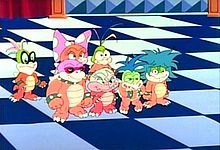
Super Mario Bros. 3 introduced several elements which were carried over to subsequent Mario titles. [29] A like overworld map is used in Super Mario Globe and New Super Mario Bros., and Mario's ability to fly has been a feature in such games as Super Mario World, Super Mario 64 and Super Mario Milky way. [11] [42] [43] Bowser's red pilus was first popularized in the game (though it was originally added in Super Mario Bros.: Peach-Hime Kyushutsu Dai Sakusen! in 1986), and has since become a office of his standard advent. [eleven] Through a collaboration between NBC and Nintendo of America, an animated television set series titled The Adventures of Super Mario Bros. 3 was created in 1990 past DIC Entertainment. The testify aired weekly and featured numerous characters, enemies, and settings from the video game; the original vii Koopalings are given dissimilar names based on their given personalities and are also given a new historic period order. [44] Other Nintendo products have included various elements from the game likewise. Music from Super Mario Bros. 3 appears as a track on Nintendo Sound Selection Koopa, a collection of songs from Nintendo games. [45] The game's stages and graphics comprise a background theme in the 2006 Nintendo DS game Tetris DS. [46] [47] The Koopalings are also earth bosses in Super Mario World, Mario is Missing!, Yoshi's Safari, Hotel Mario and New Super Mario Bros. Wii. [48] [49] In Mario & Luigi: Superstar Saga, however, they are mini-bosses in Bowser's Castle.
Remakes
Further information: Super Mario Advance 4: Super Mario Bros. three
The game has been ported to several other Nintendo consoles. In 1993, it was included in Super Mario All-Stars, a SNES compilation of enhanced remakes of NES Mario games. [fifty] A Game Boy Advance version, Super Mario Accelerate iv: Super Mario Bros. three, was released in 2003, and included several updates. [51] [52] Information technology features similar graphics to the SNES remake (the release was a port of the SNES version) along with a larger color palette and parallax scrolling, although the latter non to the same extent. The Mario Bros. minigame allows upward to 4 players instead of two, and the Nintendo e-Reader peripheral gives the player access to walkthrough demonstrations also as new items and levels. [52] In tardily 2007, Super Mario Bros. 3 was released via the Nintendo Wii'south Virtual Panel service, featuring the original graphics and gameplay of the NES version; [53] [54] similar other Virtual Console titles, it is actually the original NES ROM image running in an emulator, and is thus identical to the original.
References
- ^ a b c d due east f g h i j Nintendo Ability Staff (January/February 1990). "The Making of Super Mario Bros. 3". Nintendo Power (Nintendo) (10): xx–23.
- ^ "Mario's Basic Moves". Nintendo Ability: Strategy Guide (Nintendo) SG1 (thirteen): 4. 1990.
- ^ "Story". Super Mario Bros. three Instruction Booklet. Nintendo of America. 1990-02-12.
- ^ "The Viii Kingdoms". Super Mario Bros. 3 Instruction Booklet. Nintendo of America. 1990-02-12.
- ^ a b c d due east f Mean Machine Staff (October 1991). "Nintendo Review: Super Mario Bros. 3". Mean Machines (EMAP) (13): 56–59. http://www.meanmachinesmag.co.united kingdom/review/192/super-mario-bros-3.php.
- ^ a b c d Nintendo Ability Staff (January/Feb 1990). "Previews: Super Mario Bros. 3". Nintendo Power (Nintendo) (10): 56–59.
- ^ a b c Miller, Skyler. "allgame ((( Super Mario Bros. 3 > Overview )))". Allgame. http://www.allgame.com/game.php?id=1321 . Retrieved 2009-02-09.
- ^ "Mario'due south Power-Ups & Magical Items". Nintendo Power: Strategy Guide (Nintendo) SG1 (thirteen): 5. 1990.
- ^ Nintendo Ability Staff (May/June 1990). "Super Mario Bros. 3: Strategy Guide on the Way". Nintendo Power (Nintendo) (12): 94–95.
- ^ "How To Play The 2 Player Game". Super Mario Bros. three Instruction Booklet. Nintendo of America. 1990-02-12.
- ^ a b c d e f g h "IGN Top 100 Games 2007: 39 Super Mario Bros. three". IGN. 2007. http://top100.ign.com/2007/ign_top_game_39.html . Retrieved 2009-01-25.
- ^ a b c McLaughlin, Rus (2007-11-08). "The History of the Super Mario Bros.". IGN. http://retro.ign.com/articles/833/833615p2.html . Retrieved 2009-01-26.
- ^ Nintendo Power Staff (January 1991). "Why Your Game Paks Never Forget". Nintendo Ability (Nintendo) (20): 28–31.
- ^ Sheff, David (1993). "Game Masters". Game Over: How Nintendo Zapped an American Industry, Captured Your Dollars, and Enslaved Your Children. Random Firm. p. 222. ISBN 0679404694.
- ^ a b Sheff, David (1993). "The Grinch Who Stole Christmas". Game Over: How Nintendo Zapped an American Manufacture, Captured Your Dollars, and Enslaved Your Children. Random House. pp. 190–191. ISBN 0679404694.
- ^ McFerran, Damien (April 2008). "The Making of The Sorcerer". Retro Gamer (Imagine Publishing) (49): 84–87.
- ^ a b Matti, Michele (November/December 1989). "NES Periodical: The Sorcerer". Nintendo Power (Nintendo) (nine): ninety.
- ^ Edge Staff (July 2007). "Who Dares Wins". Border (Future Publishing) (177): 63–65.
- ^ Edge Staff (September 2008). "Return to Chief Menu". Edge (Futurity Publishing) (192): 71–72.
- ^ "任天堂が新作ソフトを一挙公開!注目のラインナップをまとめてお届け!!" (in Japanese). Dengeki. 2005-05-14. http://dol.dengeki.com/data/news/2003/05/14/3f7fd2b01ca1350e59b2b6839b22b496.html . Retrieved 2009-02-05.
- ^ a b "Top Ten NES Games". ScrewAttack. GameTrailers. 2007-ten-16. http://world wide web.gametrailers.com/video/meridian-x-screwattack/26529 . Retrieved 2009-02-06.
- ^ Sheff, David (1993). "I, Mario". Game Over: How Nintendo Zapped an American Industry, Captured Your Dollars, and Enslaved Your Children (1st ed.). Random Business firm. p. 53. ISBN 0679404694.
- ^ Nintendo Power Staff (September/October 1989). "Nintendo Power Top thirty". Nintendo Ability (Nintendo) (8): 82.
- ^ Nintendo Power Staff (March/April 1990). "Nintendo Power Tiptop xxx". Nintendo Ability (Nintendo) (eleven): 40–41.
- ^ Nintendo Power Staff (May/June 1990). "Nintendo Power Top 30". Nintendo Power (Nintendo) (12): 42–43.
- ^ Nintendo Power Staff (January 1995). "Ability Charts". Nintendo Power (Nintendo) (68): 101.
- ^ "NP Tiptop 200". Nintendo Power (Nintendo) (200): 58–66. February 2006.
- ^ (Magazine) Nintendo Power - The 20th Anniversary Issue!. Nintendo Power. 231. San Francisco, California: Futurity US. August 2008. p. 71.
- ^ a b East, Tom. "100 Best Nintendo Games - Part Five". Official Nintendo Mag. Future plc. http://www.officialnintendomagazine.co.uk/article.php?id=7297 . Retrieved 2009-02-25.
- ^ "Peak 10 Mario Games". ScrewAttack. GameTrailers. 2007-07-24. http://www.gametrailers.com/video/top-ten-screwattack/22754 . Retrieved 2009-01-24.
- ^ "【アンケート結果発表】初めてプレイしたゲームソフトはなんですか?" (in Japanese). Dengeki. 2008-07-09. http://news.dengeki.com/elem/000/000/091/91701/ . Retrieved 2009-02-05.
- ^ "IGN's Summit 100 Games: 21–30". IGN. 2005. http://top100.ign.com/2005/021-030.html . Retrieved 2009-01-25.
- ^ "Top 99 Games of All Time: Reader'southward Pick". IGN. 2005. http://microsites.ign.com/kfc/top99games/7.html . Retrieved 2009-01-25.
- ^ "Readers' Picks Top 100 Games: 21-xxx". IGN. 2006. http://top100.ign.com/2006/021-030.html . Retrieved 2009-01-25.
- ^ Chaplin, Heather (2007-03-12). "Is That Just Some Game? No, It's a Cultural Artifact". New York Times. http://www.nytimes.com/2007/03/12/arts/design/12vide.html . Retrieved 2009-02-06.
- ^ a b The Game Informer staff (Dec 2009). "The Top 200 Games of All Time". Game Informer (200): 44–79. ISSN 1067-6392. OCLC 27315596.
- ^ Sal Basile (July 6, 2010). "The Top 50 Games That Vest On the 3DS - UGO.com". UGO. http://www.ugo.com/games/the-superlative-fifty-games-that-vest-on-the-3ds?page=5 . Retrieved 2011-04-25.
- ^ Roush, George (2008-06-18). "Watching The Wizard". IGN. http://retro.ign.com/articles/882/882655p1.html . Retrieved 2009-01-25.
- ^ Buchanan, Levi (2008-06-18). "The 90-Minute Super Mario Bros. 3 Commercial". IGN. http://retro.ign.com/articles/882/882647p1.html . Retrieved 2009-01-25.
- ^ Sheff, David (1993). "A New Leader of the Lodge". Game Over: How Nintendo Zapped an American Manufacture, Captured Your Dollars, and Enslaved Your Children (1st ed.). Random Firm. pp. three–five. ISBN 0679404694.
- ^ Craig Glenday, ed (2008). Guinness World Records Gamer'south Edition 2008. Guinness World Records. section coauthored by Oli Welsh. Guinness World Records Limited. p. 110. ISBN 978-i-904994-20-half dozen.
- ^ Official Super Mario 64 Player's Guide. Nintendo. 1996.
- ^ Harris, Craig (2006-05-06). "New Super Mario Bros. Review". IGN. http://ds.ign.com/manufactures/705/705537p2.html . Retrieved 2009-02-03.
- ^ Nintendo Ability Staff (September/October 1990). "On the Air: SMB3". Nintendo Power (Nintendo) (16): 89.
- ^ "「クラブニンテンドー」の交換アイテムに"元気が出る"音楽CD「クッパ」が登場!" (in Japanese). Dengeki. 2004-12-xvi. http://dol.dengeki.com/data/news/2004/12/16/696eec8e065cb4f0abd9d5766171561b.html . Retrieved 2009-02-05.
- ^ Vore, Bryan (2006-01-eleven). "Beginning Tetris DS Screenshots". Game Informer. http://play.tm/wire/751754/starting time-tetris-ds-screenshots/ . Retrieved 2009-02-05.
- ^ 石田, 賀津男 (2006-08-06). "任天堂、マリオなどが登場する定番パズルゲームDS「テトリスDS」" (in Japanese). Impress Watch. http://game.lookout.print.co.jp/docs/20060308/tetris.htm . Retrieved 2009-02-05.
- ^ Thomas, Lucas One thousand.. "IGN: E3 2009: Return of the Koopalings?". Wii.ign.com. http://wii.ign.com/manufactures/990/990242p1.html . Retrieved 2009-08-18.
- ^ "New Super Mario Bros. Wii Stage Demo" (Flash). GameSpot. 4 June 2009. http://www.gamespot.com/wii/action/newsupermariobroswii/video/6211673 . Retrieved 12 December 2009.
- ^ "Super Mario All-Stars for SNES: Release Summary". GameSpot. http://world wide web.gamespot.com/snes/activity/supermariocollection/similar.html?mode=versions . Retrieved 2009-01-27.
- ^ "Super Mario Accelerate 4: Super Mario Bros. 3 for Game Boy Advance: Release Summary". GameSpot. http://www.gamespot.com/gba/action/supermarioadvance4/similar.html?mode=versions . Retrieved 2009-01-27.
- ^ a b Davis, Ryan (2003-10-17). "Super Mario Advance 4: Super Mario Bros. 3 Review". GameSpot. http://world wide web.gamespot.com/gba/activity/supermarioadvance4/review.html . Retrieved 2009-01-27.
- ^ "Super Mario Bros. three for Wii: Release Summary". GameSpot. http://www.gamespot.com/wii/action/supermariobros3/like.html?mode=versions . Retrieved 2009-01-27.
- ^ Provo, Frank (2007-12-19). "Super Mario Bros. 3 Review". GameSpot. http://www.gamespot.com/wii/activeness/supermariobros3/review.html . Retrieved 2009-01-27.
External links
- Super Mario Bros. three (Virtual Console version) at Nintendo'southward website
- Super Mario Bros. three on Nintendo Wiki, an external wiki
- Super Mario Bros. 3 at Super Mario Wiki
- Super Mario Bros. 3 at NinDB
- Super Mario Bros. 3 at The Mushroom Kingdom: Super Mario Bros. downloads and information
- Super Mario Bros. three at Mobygames - The Authoritative Video Game Database
| Games directed by Shigeru Miyamoto | |
|---|---|
| 1980s | Donkey Kong (1981)· Ass Kong Jr. (1982)· Donkey Kong three (1984)· Super Mario Bros. (1985)· The Legend of Zelda (1986)· Super Mario Bros.: The Lost Levels (1986)· Super Mario Bros 3 (1988) |
| 1990s | Super Mario 64 (1996)· The Legend of Zelda: Ocarina of Time (1998) |
| Mario series | ||||||
|---|---|---|---|---|---|---|
| Games by year • Games by console • Games by genre • Media | ||||||
| Arcade games | Donkey Kong • Ass Kong Junior • Mario Bros. | |||||
| Chief series |
| |||||
| Spin-off games | Pinball • Wrecking Coiffure • Mario Bros. Two • Ass Kong (Game Boy) • Mario'southward Time Automobile • Hotel Mario • Mario'southward Game Gallery • Mario Clash • Wario Land: Super Mario Land 3 • Super Mario World two: Yoshi's Island • Luigi'south Mansion • Mario Pinball Land • Super Princess Peach • Luigi's Mansion 2 | |||||
| Spin-off series | Mario Party • Sports games • Role-playing games • Educational games • LCD games • Donkey Kong • Wario • Yoshi • Mario vs. Donkey Kong • Game & Watch Gallery | |||||
| Remakes | Super Mario All-Stars • Super Mario Advance 4: Super Mario Bros. 3 • Super Mario 64 DS | |||||
| Other media | Idiot box series • Film • Comics (Super Mario Adventures) • Anime • Super Mario-kun • Gamebooks | |||||
| Related articles | Mario characters • Super Mario Bros. theme • Super Mario 128 • Super Mario's Wacky Worlds | |||||
| Unofficial media | Dian Shi Mali • Kart Fighter • Somari • Super Mario Bros. Crossover | |||||
 Book:Mario titles Book:Mario titles | ||||||

Super Mario Bros 3 Initial Release Date,
Source: https://en-academic.com/dic.nsf/enwiki/49121
Posted by: castleevand1953.blogspot.com
0 Response to "Super Mario Bros 3 Initial Release Date"
Post a Comment